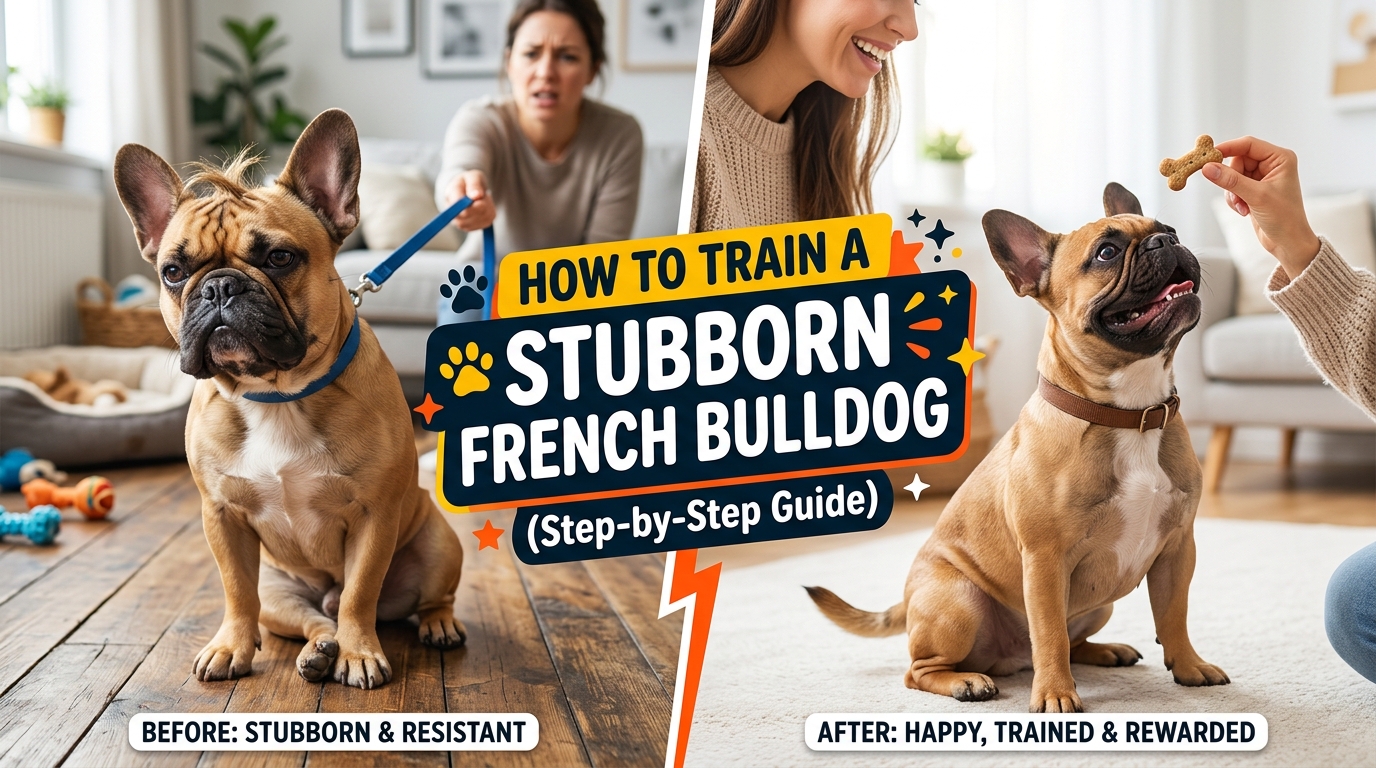
Training a stubborn dog can feel frustrating at first, especially when your French Bulldog seems to ignore commands, gets easily distracted, or refuses to follow instructions consistently. However, what is often labeled as “stubbornness” is usually not deliberate disobedience. In most cases, it comes from a mix of factors such as inconsistent training routines, unclear communication from the owner, low motivation due to weak rewards, or simply the dog being more interested in its surroundings than the task at hand. French Bulldogs are intelligent but also known for their independent streak, which means they don’t always respond to commands unless they clearly understand what is expected and see a reason to comply.
With the right structure, patience, and positive reinforcement strategy, training a French Bulldog becomes not only manageable but also enjoyable and rewarding. The key is to build a routine that the dog can understand and predict, using short, focused training sessions, clear verbal cues, and consistent rewards like treats, praise, or play. Over time, repetition helps the dog connect actions with outcomes, which significantly improves responsiveness. This guide will walk you step by step through the process of training a “stubborn” French Bulldog, focusing on practical methods that strengthen communication, increase motivation, and create long-term good behavior through consistency rather than force.
1) Understand Your French Bulldog’s Learning Style
Before starting any French Bulldog obedience training, it is essential to first understand how this breed actually thinks, learns, and responds to instruction. Many training challenges come not from the dog being “difficult,” but from a mismatch between the dog’s natural learning style and the way training is being delivered.
French Bulldogs are generally intelligent, affectionate, and highly people-oriented dogs. They tend to form strong bonds with their owners and enjoy attention and companionship. However, they are also known for having a strong independent streak and can quickly lose interest if they feel a task is repetitive, confusing, or unrewarding. Unlike some working breeds that are naturally driven to follow commands, French Bulldogs often require more encouragement and motivation to stay engaged.
What is often interpreted as stubbornness is usually a combination of simple but important factors. For example, the dog may not be sufficiently motivated by the reward being offered—meaning the treat, toy, or praise is not exciting enough to capture its attention. In other cases, the environment may be too distracting, with noises, people, or other animals pulling the dog’s focus away from the training session. Another common issue is training sessions that are too long or repetitive, causing the dog to lose interest and mentally “switch off.” Additionally, inconsistent rules from the owner—such as allowing a behavior sometimes but correcting it at other times—can confuse the dog and slow down learning.
Once you understand these underlying causes, your approach to training naturally changes. Instead of trying to force obedience or expecting immediate compliance, the focus shifts toward creating motivation and clarity. This means using high-value rewards, keeping training sessions short and engaging, reducing distractions, and maintaining consistent rules so the dog clearly understands what is expected.
What is often labeled as stubbornness is usually:
- Lack of engagement with the reward being offered
- Too many distractions in the environment
- Training sessions that are too long or repetitive
- Inconsistent rules from the owner
Once you understand this, the goal shifts from “forcing obedience” to “creating motivation.”
2) Build a Strong Foundation Using Positive Reinforcement
One of the most effective, reliable, and beginner-friendly methods for training a French Bulldog is positive reinforcement training. This approach is based on a simple but powerful principle: your dog learns to repeat behaviors that lead to something enjoyable or rewarding. Instead of focusing on punishment for mistakes, you actively teach your French Bulldog what the correct behavior looks like and immediately reinforce it when it happens.
At its core, this method creates a clear communication system between you and your dog. When your French Bulldog performs a desired action—such as sitting when asked, making eye contact, or coming when called—you instantly reward that behavior. Over time, the dog begins to understand that “listening to my owner = good things happen.” This understanding is what builds long-term obedience and reliability.
Positive reinforcement is especially important for French Bulldogs because of their personality traits. They are intelligent and capable of learning quickly, but they are also known for being selective in what they choose to respond to. If something doesn’t feel rewarding or interesting enough, they may simply ignore it. This is why traditional harsh correction methods often fail with this breed. Punishment can create confusion, reduce trust, and in some cases make the dog even more resistant to training. On the other hand, reward-based training keeps them engaged, curious, and willing to participate.
A key part of success with this method is understanding that not all rewards are equal. French Bulldogs can be highly food-driven, but they still have preferences. This means you may need to experiment to find what your dog values most. High-value food rewards usually work best during early training stages or in distracting environments. These can include small pieces of boiled chicken, tiny soft training treats that can be eaten quickly without interrupting the flow of training, or small amounts of cheese used sparingly. In addition to food, non-food rewards are equally important. Enthusiastic verbal praise, a happy tone of voice, gentle petting, and physical affection can all reinforce good behavior and strengthen your bond with your dog.
Timing is one of the most critical elements of positive reinforcement. The reward must be given immediately—within a second or two—after the desired behavior occurs. If there is a delay, the dog may not connect the reward with the correct action, which slows down learning. Consistency is also essential. Every time your French Bulldog performs the correct behavior, it should be rewarded during the learning phase so the pattern becomes clear and predictable.
This method is particularly powerful when working with a stubborn or easily distracted Frenchie. Instead of trying to “force” obedience, you are guiding the dog through repetition, motivation, and clear feedback. Over time, the dog begins to actively offer good behavior because it expects a positive outcome. This transforms training from a struggle for control into a cooperative learning process, where your French Bulldog becomes more attentive, responsive, and eager to engage.
Why it works:
French Bulldogs are highly food-motivated, so they respond best when training is rewarding rather than corrective.
Recommended rewards:
- Small pieces of boiled chicken
- Soft training treats
- Cheese (in moderation)
- Praise and physical affection
This approach is essential for positive reinforcement training for French Bulldogs, especially when dealing with a stubborn Frenchie that resists commands.
3) Establish Focus Before Teaching Commands
One of the most commonly overlooked—but absolutely essential—steps in a successful French Bulldog training routine at home is attention or focus training. Many owners make the mistake of jumping straight into commands like “sit,” “stay,” or “come,” without first ensuring that the dog is actually mentally engaged with them. If your French Bulldog is not paying attention to you, any command you give will likely be ignored or only partially followed, not because the dog is disobedient, but because the communication channel is not active.
French Bulldogs, in particular, are easily distracted by sounds, smells, movement, and their surroundings. This means that before you can expect consistent obedience, you must first teach your dog that focusing on you is rewarding in itself. Once attention becomes a habit, every other command becomes significantly easier to teach and maintain.
A simple but highly effective exercise for building this foundation is the “Name + Eye Contact” training method. The purpose of this exercise is to condition your dog to automatically pause and check in with you whenever it hears its name.
Start by saying your dog’s name once in a calm, clear voice. Do not repeat it multiple times, as this can reduce its meaning over time. After saying the name, remain patient and wait for your dog to naturally look toward you. The moment your French Bulldog makes eye contact—even if it is just for a second—you should immediately reward it. The reward can be a small treat, verbal praise, or gentle affection, but the key is that it must come instantly so the dog clearly understands that making eye contact is the correct response.
This exercise should be repeated frequently throughout the day in very short sessions rather than long training blocks. You can practice it in different rooms of the house, during calm moments, or even when your dog is slightly distracted, gradually increasing the difficulty as your dog improves. Over time, your French Bulldog begins to learn that responding to its name and checking in with you is always worth its effort.
This focus-building habit becomes the foundation for all future training. Once your dog consistently pays attention to you, teaching commands like “sit,” “stay,” “down,” and “come” becomes much more effective because you are no longer competing with distractions—you already have your dog’s attention.
Attention exercise (“Name + Eye Contact”):
- Say your dog’s name once
- Wait for eye contact
- Immediately reward
- Repeat in short bursts throughout the day
This builds engagement and becomes the foundation for all dog training tips moving forward.
4) Teach Basic Commands in a Structured Order
A very common mistake in French Bulldog obedience training—especially when owners are eager for quick results—is trying to teach multiple commands at the same time. This often leads to confusion for the dog, inconsistent responses, and slower overall progress. French Bulldogs learn best when training is broken down into clear, simple steps with repetition and consistency. That’s why following a structured order is essential for building strong and reliable obedience.
Instead of jumping randomly between commands, it is more effective to introduce them in a logical progression, starting with the easiest and most foundational behaviors. Each command builds on the previous one, helping your dog gain confidence and understand patterns more clearly.
Step 1: Sit
The “sit” command is usually the first and most important behavior to teach because it naturally creates calmness and control.
Begin by holding a small treat close to your French Bulldog’s nose so you have its attention. Slowly move your hand upward and slightly back over its head. As the dog follows the treat with its eyes and nose, its natural body movement will cause it to lower its back end into a sitting position.
The moment your dog sits fully, you should immediately mark the behavior (using a word like “yes” or a clicker) and reward it right away with the treat and praise. Timing is very important here because your dog needs to clearly understand that sitting is what earned the reward. Repeating this process consistently helps the dog quickly associate the word “sit” with the physical action.
Step 2: Stay
Once your French Bulldog understands how to sit on command, you can introduce “stay,” which teaches impulse control and patience.
Start by asking your dog to sit first. Once it is in a sitting position, take one small step back while maintaining eye contact. At this stage, even a short moment of staying still is a success. If your dog remains calm and does not move toward you, immediately step back in, reward, and praise.
If the dog breaks the position, simply reset and try again without frustration. The goal is to build success gradually, not to enforce perfection immediately.
As your dog improves, you can slowly increase both the distance and the duration of the stay. Over time, your French Bulldog will learn that remaining calm and stationary leads to positive outcomes, even when you move away.
Step 3: Down
The “down” command encourages relaxation and is especially useful for managing energy and excitement.
Start with a treat in your hand and allow your dog to sniff it. Slowly guide the treat from the nose down toward the floor. Then gently move it forward along the ground so the dog naturally follows the motion.
As your French Bulldog lowers its body and lies down completely, immediately reward and praise the behavior. It is important to only reward when the full “down” position is achieved, not halfway movements, so the dog clearly understands the final expected posture.
These three basic commands—sit, stay, and down—form the core foundation of French Bulldog obedience training. Once your dog reliably understands and responds to them, it becomes much easier to introduce more advanced behaviors and build overall discipline, structure, and good manners in daily life.
5) Use Clear Communication Without Repeating Commands
If your goal is to understand how to make a French Bulldog listen consistently, then clear and intentional communication is one of the most important skills you need to develop as an owner. Dogs do not understand human language in the way people do—they learn through patterns, tone, repetition, and association. When a command is repeated too many times, it stops carrying meaning and instead becomes background noise for the dog.
One of the most common training mistakes is repeating commands over and over, which unintentionally teaches the dog that it does not need to respond immediately. For example, if a dog hears “sit” multiple times before any action is required, it may learn to delay responding because it expects the command to be repeated several times before anything happens. This weakens obedience over time and makes training less effective.
The correct approach is to use a simple, structured communication pattern. You should say the command only once, in a clear and consistent tone. After giving the command, pause and give your dog a few seconds to process what you are asking. French Bulldogs may need a short moment to shift their focus, especially if they are distracted or still learning the behavior. This pause is important because it gives the dog an opportunity to think and respond without pressure or confusion.
If your French Bulldog does not respond immediately, you can gently guide it into the correct position using body language, hand signals, or lure-based techniques—especially during the learning phase. Once the dog completes the correct action, you must reward it immediately so it clearly understands what behavior earned the positive outcome. Over time, this reduces the need for guidance because the dog begins to respond to the verbal cue alone.
On the other hand, repeating commands like “Sit, sit, sit, SIT!” should be avoided. This pattern dilutes the meaning of the word and reduces its authority. Instead, saying “Sit” once and then calmly guiding the dog if needed creates a much stronger learning structure. It teaches the dog that the first command matters and that action is expected right away, not after multiple reminders.
This simple adjustment in communication style can significantly improve your French Bulldog’s responsiveness. When commands are consistent, clear, and followed by correct timing, your dog begins to understand expectations more quickly, leading to better obedience, stronger focus, and a more structured training experience overall.
6) Train Reliable Recall (“Come” Command)
One of the most important and potentially life-saving skills in French Bulldog training for beginners is reliable recall, commonly taught through the “come” command. This behavior means your dog responds immediately when called and returns to you regardless of distractions. However, many owners struggle with this, especially outdoors where smells, sounds, and other animals can easily compete for the dog’s attention.
French Bulldogs are naturally curious and easily stimulated by their environment, which is why recall training must be built gradually and very intentionally. The goal is not just to teach the word “come,” but to create a strong emotional association where coming back to you is always rewarding, safe, and enjoyable.
Step-by-Step Recall Training
Begin in a calm, distraction-free environment such as a quiet room inside your home. This helps your French Bulldog focus entirely on you without competing stimuli. Start at a short distance so success is easy and consistent.
Say the word “come” once in a friendly, upbeat tone. Your tone matters significantly here—it should sound inviting rather than demanding or strict. Immediately after giving the command, gently move backward or crouch down to encourage your dog to follow you. Most dogs naturally move toward motion, so this creates a chasing or following instinct that makes learning easier.
As soon as your French Bulldog reaches you, reward it enthusiastically. This should be a high-value reward, such as a tasty treat combined with verbal praise and affection. The reward should feel exciting enough that your dog starts to associate “coming to me” with something extremely positive.
Once your dog consistently responds indoors, you can begin slowly increasing the distance between you and your dog. After that, you can gradually introduce mild distractions, such as other people in the room or background noise. Over time, this helps your French Bulldog learn to respond even when its attention is divided.
Eventually, training should progress to outdoor environments, but this should only be done once indoor recall is reliable. Outdoors, start in secure, low-distraction areas before moving to more challenging spaces like parks.
Important Rule
Never punish your French Bulldog after it comes to you, even if it took a long time or ignored you initially. Punishing after recall creates confusion and breaks trust, because your dog begins to associate coming back with negative consequences. This can seriously damage training progress and make your dog less likely to return in the future.
Instead, always make coming to you a positive and rewarding experience, regardless of the situation. This builds reliability over time and ensures your French Bulldog sees you as a safe and rewarding place to return to.
Step-by-step recall training:
- Start in a distraction-free room
- Say “come” in a friendly tone once
- Move backward to encourage chasing behavior
- Reward heavily when your dog reaches you
- Gradually increase distance and distractions
Important rule:
Never punish your dog after they come to you. This breaks trust and slows progress.
7) Manage Leash Behavior Early and Consistently
Leash pulling is one of the most common challenges in leash training for stubborn French Bulldogs, and it often develops very quickly if not addressed early. Although French Bulldogs are small in size, they are surprisingly strong and compact, which means even mild pulling can become difficult to control over time if the habit is allowed to form. This is why leash training should begin as early as possible and be handled with consistency from the very first walks.
Many owners mistakenly assume that pulling is just excitement, but in reality it is a learned behavior. If a dog learns that pulling forward results in continued movement and exploration, the behavior becomes reinforced. Over time, the dog begins to believe that pulling is the correct way to move forward, making walks stressful and harder to manage.
To correct this, you need to teach your French Bulldog a very clear rule: forward movement only happens when the leash is loose.
Effective Leash Training Method
Start by using a short but relaxed leash. The leash should be short enough to maintain control, but not so tight that it creates constant tension. The goal is communication, not restriction.
Begin walking at a normal pace, and the moment your French Bulldog starts pulling ahead or creating tension on the leash, you must immediately stop moving. Do not continue walking while the leash is tight, because this teaches the dog that pulling still leads to progress.
Stay completely still and wait. Your dog may initially continue pulling, but eventually it will pause and loosen the tension naturally. The instant the leash becomes loose again, resume walking forward. This creates a clear cause-and-effect pattern: pulling stops movement, calm walking allows movement.
To strengthen this learning process, frequently reward moments of calm walking. This can be done with verbal praise, treats, or brief affection while the dog is walking beside you with a loose leash. These small rewards help your French Bulldog understand that staying close and relaxed is the behavior that gets reinforced.
Why This Works
This method is effective because it removes the reward from pulling behavior and shifts it toward calm, controlled walking. Instead of using force or correction, it teaches the dog through experience that pulling does not achieve the desired result. Over time, your French Bulldog begins to self-correct, choosing to walk calmly beside you in order to continue moving forward.
With consistency, this approach transforms chaotic walks into structured, controlled, and enjoyable experiences for both you and your dog.
8) Use Short, Structured Training Sessions
A crucial but often underestimated part of building an effective and easy French Bulldog training routine at home is understanding how long each training session should last. Many owners assume that longer training sessions will produce faster results, but for French Bulldogs, this usually has the opposite effect. Because of their relatively short attention span and tendency to lose interest when tasks become repetitive, they learn far more effectively through short, focused bursts of training rather than extended practice periods.
When training sessions are too long, your French Bulldog can become mentally fatigued, distracted, or even frustrated. Once this happens, learning slows down significantly, and the dog may start ignoring commands or offering random behavior simply to disengage from the task. Short sessions, on the other hand, help maintain focus, keep energy levels balanced, and ensure that each repetition is meaningful.
Ideal Training Structure
For best results, each training session should be kept between 5 to 10 minutes. This time frame is long enough to practice effectively but short enough to keep your French Bulldog engaged and responsive throughout the session. Instead of trying to cover everything at once, it is more productive to focus on 2 to 4 short sessions per day, spaced out at different times. This repetition throughout the day helps reinforce learning without overwhelming your dog.
Within each session, it is best to focus on only one or two commands at a time. For example, one session may focus solely on “sit” and “stay,” while another later in the day focuses on “down” or recall practice. This separation helps your French Bulldog clearly understand what is being taught and prevents confusion caused by switching between too many commands too quickly.
Another important principle is to always end each session on a successful repetition. This means finishing training on a positive note where your dog successfully performs a command and receives a reward. Ending on success builds confidence and leaves your French Bulldog with a positive association with training, making it more eager to participate in future sessions.
Why This Matters
Short, structured training sessions prevent mental overload and help maintain high motivation levels. Instead of feeling pressured or bored, your French Bulldog stays engaged, focused, and more willing to learn. Over time, this approach leads to faster progress, stronger command retention, and a more enjoyable training experience for both you and your dog.
Ideal structure:
- 5–10 minute sessions
- 2–4 sessions per day
- One or two commands per session
- Always end on a successful repetition
This prevents mental fatigue and keeps motivation high.
9) Address Behavioral Problems Through Redirection
If you are wondering why your French Bulldog seems stubborn and how to fix it, the solution is usually not punishment, but consistency combined with redirection. Most unwanted behaviors are not intentional disobedience—they are often the result of excess energy, lack of clear guidance, or the dog learning that certain behaviors get attention or results.
French Bulldogs commonly show behaviors such as jumping on people, excessive barking, ignoring commands, or pulling on the leash. These behaviors tend to persist when they are either accidentally rewarded (for example, giving attention when the dog jumps) or not properly guided toward an alternative behavior.
The most effective way to handle these issues is to redirect your dog’s energy and attention toward a behavior that you do want to reinforce. Instead of simply stopping a bad behavior, you replace it with a clear, acceptable alternative. For example, if your French Bulldog jumps on guests, you can calmly ask for a “sit” and only give attention or greetings once your dog is sitting calmly. This teaches the dog that calm behavior is what earns interaction.
Timing plays a critical role here. You must reward the correct behavior immediately so your French Bulldog clearly connects the action with the outcome. If your dog sits instead of jumping and you reward that moment right away, it begins to understand that sitting is the better choice.
Another important technique is ignoring attention-seeking behaviors when it is safe to do so. If your dog is barking or demanding attention, avoid reacting immediately. Many dogs repeat these behaviors because they receive some form of response—even negative attention. By withholding attention until your dog calms down, you reduce the reinforcement of unwanted behavior and encourage self-control over time.
Through consistent redirection, your French Bulldog gradually learns that calm, controlled behavior is more rewarding than impulsive actions. Over time, this reshapes habits without stress, fear, or punishment, leading to more stable and predictable behavior patterns.
10) Use Capture Training to Strengthen Natural Behavior
Capture training is a highly effective and often overlooked technique in French Bulldog training for beginners. Unlike traditional methods that involve luring or forcing behavior, capture training focuses on rewarding behaviors your dog naturally offers on its own. This makes learning feel more intuitive and less stressful for the dog.
The core idea is simple: instead of making your dog perform a behavior, you wait for it to happen naturally and then reinforce it immediately. This helps your French Bulldog associate natural actions with commands and rewards, strengthening both understanding and repetition.
For example, if your dog naturally sits down on its own, you can immediately reward it and label the behavior by saying “sit.” Over time, your French Bulldog begins to associate that action with the word and reward, making it easier to reproduce on command later. Similarly, if your dog lies down calmly, you can reward it and introduce the word “down” in that moment. If your dog is resting quietly without barking or demanding attention, you can reinforce that calm behavior with praise or treats, teaching that being quiet is valuable.
What makes capture training especially powerful is that it builds on behaviors your dog already understands or performs instinctively. Because the dog is not being forced into position, it reduces frustration and increases engagement. Instead, the dog actively discovers that its natural choices are being rewarded.
Over time, this method helps create a strong mental connection between behavior, command, and reward. Your French Bulldog starts repeating positive behaviors more often, and you can gradually assign verbal cues to those actions. This results in smoother learning, better retention, and a more cooperative training experience overall.
11) Build Consistency Into Daily Life
Long-term success in French Bulldog obedience training depends far more on consistency than on short bursts of intense training. Many owners make the mistake of focusing only on structured training sessions, but in reality, your dog is learning all day through everyday interactions, routines, and responses. Every time you react to your French Bulldog—whether during feeding, walking, greeting, or play—you are reinforcing either good habits or unwanted behaviors.
Consistency means creating a stable and predictable environment where your dog always receives the same message for the same behavior, regardless of the situation or mood. French Bulldogs learn best when rules are clear and repeated in the same way over time. If expectations change frequently, the dog becomes confused about what is allowed and what is not, which often appears as stubbornness or selective listening. In most cases, the issue is not defiance, but unclear communication caused by inconsistency.
A major principle of consistency is using the same commands every single time. Dogs do not understand variations in wording the way humans do. For example, using “sit,” “sit down,” or “can you sit?” interchangeably may seem natural to us, but to a dog, these can sound like completely different cues. Keeping commands short, consistent, and identical across all situations helps your French Bulldog build strong, reliable associations much faster and reduces confusion during training.
It is equally important that all members of the household follow the same rules and expectations. If one person allows your French Bulldog to jump on furniture or greet people excitedly while another corrects the same behavior, the dog receives conflicting signals. This inconsistency can slow progress significantly and may lead to repeated boundary testing, where the dog tries different behaviors to see what is allowed with each person. When everyone follows the same rules, your dog learns faster because the environment becomes predictable and structured.
Another key part of consistency is ensuring that good behavior is reinforced regularly, especially during the learning phase. If your French Bulldog sits calmly or responds correctly sometimes but is ignored at other times, the behavior becomes less reliable because the reward connection is weak. Consistent reinforcement helps your dog clearly understand which actions are valuable and worth repeating. Over time, this builds strong behavioral habits that become automatic.
At the same time, it is important to avoid mixed signals in daily life. For example, if jumping on people is sometimes allowed during excitement but discouraged in other situations, your French Bulldog cannot clearly understand the rule. This inconsistency leads to confusion and makes behavior harder to manage. Clear, consistent boundaries remove uncertainty and help your dog feel more secure, which naturally improves obedience and calmness.
Ultimately, consistency creates clarity, and clarity builds obedience. When your French Bulldog knows exactly what is expected in every situation, it becomes more confident, more stable in behavior, and significantly easier to train both at home and in public environments.
Conclusion
Training a stubborn French Bulldog is not about dominance, force, or control—it is about building clear communication through patience, structure, and motivation. A well-trained French Bulldog is the result of repeated positive experiences where the dog understands what is expected and feels rewarded for making the right choices.
When you consistently apply structured French Bulldog training tips, use positive reinforcement instead of punishment, and maintain clear rules across all situations, even a highly stubborn Frenchie can transform into a responsive, attentive, and well-behaved companion.
With time, repetition, and consistency, your dog will not only follow commands more reliably but will also begin to actively participate in training sessions. This turns training into a positive daily routine rather than a struggle, strengthening both obedience and the bond between you and your French Bulldog.